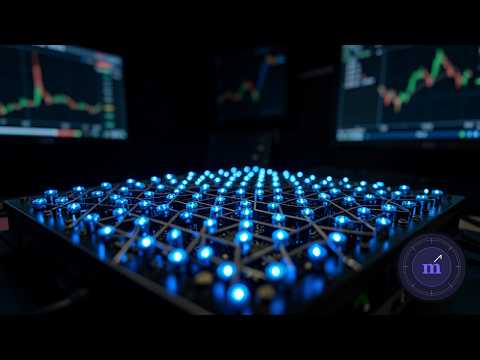
In the quiet hum of server rooms where computers tirelessly work, a revolution is brewing—one that whispers the promise of solving the unsolvable. Quantum computing, once a mere specter of science fiction, is on the verge of redefining our financial landscape with its vast computational potential. To appreciate this unfolding evolution, let’s sit with the distinction between classical and quantum computing, then unravel its profound implications.
Based on content from Finsteon Finance
Consider the typical computer, a reliable companion in our daily lives, using bits as its language—those familiar zeros and ones. This binary system, with its predictable logic, has powered everything from our emails to our online purchases. Yet, as efficient as it is, there are puzzles it cannot solve, tasks it cannot compute within feasible timeframes. Imagine trying to unlock a door with billions of keys by testing each one individually; the limits of classical computation become evident.
Enter quantum computing, where the narrative shifts dramatically. Utilizing quantum bits, or qubits, a quantum computer stands defiant against this problem. With its ability to embody both zero and one simultaneously, thanks to the principles of quantum mechanics, it explores an expanse of possibilities in a single breath. It’s not just about speed; it’s about a paradigmatic shift in how problems are approached—how solutions are envisioned. This revolutionary thinking is why industries from healthcare to material science are peering eagerly into quantum’s depths. But in the realm of finance, a space characterized by copious data and complexity, quantum’s promise is particularly tantalizing.
For financial markets, quantum computers represent a new compass in a dizzying maze of numbers and uncertainty. Our modern financial systems lean heavily on traditional computers; from processing transactions and adjusting portfolios to predicting market trends, these systems operate under relentless pressure. Speed and accuracy are paramount. A millisecond’s delay can spell a hefty financial loss. As you step back to consider the stock market—a volatile organism influenced by myriad factors—you’ll see the sheer scope of variables a financial model must juggle. A classical computer can but grasp at shadows, leaving paths uncovered, insights elusive.
This is where quantum computing steps into the spotlight, offering clarity in chaos. Major financial institutions like Yappy are already tapping into quantum’s potential. Using D-Wave’s technology, Yappy modeled complex financial interactions at remarkable speeds—a forecast that once took years now resolved in mere seconds. Such efficiency reshapes risk management by identifying vulnerabilities before they manifest into crises. Similarly, HSBC is bolstering its defenses with post-quantum cryptography to preempt tomorrow’s cyber threats. Drawing inspiration from a future not yet realized, banks are girding their systems, ensuring that security evolves as fast as the technology it aims to protect.
The investment landscape is not untouched by quantum’s allure. While companies like Quantum Computing Inc. see their valuation soar on the wings of potential rather than present performance, the excitement runs the risk of outstripping realistic outcomes. Here lies a fair caution for investors—distinguishing the visionary from the speculative. The fascinating promise of quantum technology invites a closer examination of its feasibility versus its fanfare.
As 2025 unfurls, we stand at a curious juncture, staring into a horizon painted by quantum possibilities. It beckons us to dream but also to tread carefully. The path is fraught with challenges, not the least of which is the allure of hype over substance. Yet, in this uncertainty lies opportunity—a chance to redefine financial systems, to bring forth an era where efficiency and security are more than ideals; they become attainable realities.
The dialogue surrounding quantum computing in finance is not merely technical; it is deeply reflective of where human ingenuity can lead. With each breakthrough comes the responsibility to weigh both the unprecedented potential and the inherent risks. As we collectively navigate the voyage into this new frontier, the question isn’t just about what quantum technology can achieve but also how we adapt to its disruptive rhythm.
—