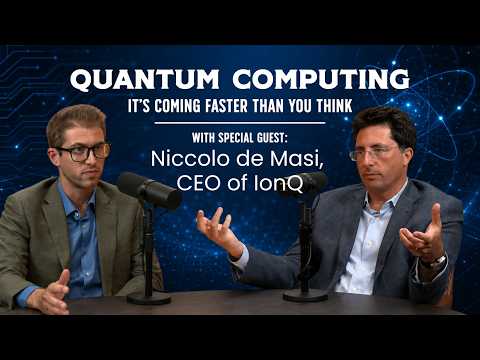
The world of quantum computing, where possibilities once confined to theoretical frameworks begin to manifest as tangible realities, is a realm of quiet, profound complexity. IonQ, a key player in this mystical sphere, strides forward, testing the boundaries of known capabilities with its newly developed 256-qubit QPUs. Their journey, marked by aggressive investments and strategic acquisitions, suggests a future not merely imagined but realized, albeit step by cautious step.
Based on content from LIVICUS
The world of quantum computing, where possibilities once confined to theoretical frameworks begin to manifest as tangible realities, is a realm of quiet, profound complexity. IonQ, a key player in this mystical sphere, strides forward, testing the boundaries of known capabilities with its newly developed 256-qubit QPUs. Their journey, marked by aggressive investments and strategic acquisitions, suggests a future not merely imagined but realized, albeit step by cautious step.
In the second quarter of 2026, IonQ announced an impressive 287% jump in revenue, reaching $80.1 million. This spike speaks volumes about its intensified focus on research and development, alongside the strategic scaling of operations—a calculated risk mirrored in their 106% rise in operating expenses. As with all daring ventures, financial solidity becomes pivotal; IonQ assures with a cash reserve of approximately $2 billion, a buffer against the uncertainties that innovation naturally courts.
Exploring IonQ’s technological roadmap feels akin to watching an intricate tapestry being woven, each thread a milestone readying the world for scalable quantum systems. Transitioning from the 100-qubit Tempo system, they now test their 256-qubit QPUs, promising leaps in fidelity and control—attributes fortified through strategic acquisitions like Skywater and Oxford Ionics. Their integration of semiconductor-based technologies coupled with state-of-the-art cubit control aims to transition quantum computing from the nascent stages of feasibility to practical, scalable application.
Beyond the achievements of 256-qubit systems, IonQ’s endeavors include acquiring Nexus Photonics, itself a beacon of innovation, enhancing scalability with integrated photonics and optic technologies. Furthermore, their collaboration with Andero to pioneer advancements in defense and security underscores a prudent awareness of the technology’s dual-edged potential—promising unparalleled security but also posing encryption risks as quantum capabilities mature.
These advancements surface essential questions: how will societies harness quantum computing’s power responsibly, ensuring its advancements do not outpace ethical considerations? IonQ lives at this juncture, its mission both a harbinger and shield within an advancing technological landscape.
It is crucial to address the inherent risks accompanying this bold pursuit. True, quantum systems capable of fault tolerance and comprehensive encryption solutions are still years away. The promise of cracking existing encryption methods eventually heralds a paradigm shift in cybersecurity. IonQ, candidly aware of these risks, stresses the importance of continued advancement, citing international pursuits, notably by China, as compelling evidence against stalling progress.
As investors and onlookers navigate the intricate dance of risk and reward, IonQ offers a compelling, albeit challenging, narrative. Their strategic acquisitions, escalating proficiency, and an unwavering march towards commercial-scale quantum computing invite us to participate in an unfolding future. Yet, caution dictated by complexity stands tall—an unspoken acknowledgment that in this high-stakes arena, success demands patience, scrutiny, and thoughtful presence at each step.
In closing, IonQ’s quarterly journey leaves us with more questions than answers, a hallmark of exciting times. Will they continue to lead the charge towards a practical quantum future, or will unexpected challenges recalibrate their trajectory? Whatever the case, they invite us to watch, consider, and perhaps, in this symphony of particles and potential, find a role that transforms not just computing but the very fabric of societal progress.
—