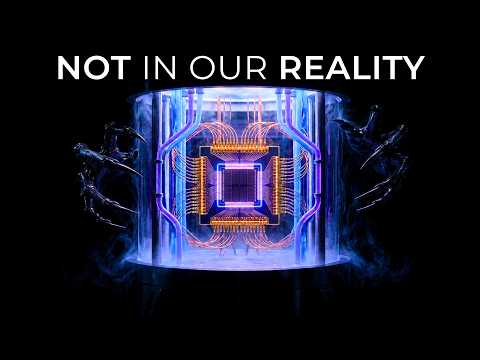
In Villach, Austria, surrounded by the Alps, engineers are working on technology that could change how we think about computing. Inside their labs, they’re exploring something we can’t see with the naked eye: the unusual behavior of particles at the quantum level.
Imagine a single ion, an atom that has lost an electron, suspended in an almost perfect vacuum. It isn’t resting on anything. Instead, carefully controlled electric fields hold it in place, isolated from much of the surrounding environment.
Then something remarkable happens. A laser is directed at the ion, and a tiny point of light appears. For a moment, something normally invisible becomes visible.
What caught my attention is how much science sits behind that small flash of light. Researchers use lasers to manipulate and measure ions, taking advantage of quantum properties such as superposition and entanglement. These are the same principles that could allow quantum computers to solve certain problems in ways today’s computers cannot.
And it is all happening in Villach, a town better known for its mountains than its quantum research. There’s something fascinating about that contrast. Outside, the landscape has remained familiar for centuries. Inside, scientists are learning how to control some of nature’s smallest building blocks, one ion at a time.
Based on content from Anastasi In Tech
As a chip designer-turned-explorer, I witness photonics and quantum mechanics knitting together in harmony. Once the province of theory alone, entanglement — the quantum flirtation that Einstein himself disdained as “spooky action at a distance” — is here realized as a tool for calculations, a story told in bursts of light and binary silence. Theirs is a union that calculates with a deftness that even spans vast distances, crafting a narrative of computation that is both intricate and seamless.
Within the cathedral-like confines of the chip factory, as close to pristine as designed environments allow, another drama unfolds: layer by layer, an ordinary silicon wafer is alchemized into an ion trap chip, effortlessly bridging the gap between conventional electronics and esoteric quantum potential. It is a roadmap scattered not with road markers but light waves and atoms, where the orange glow of filtered light bathes the room in caution, safeguarding the wafer’s delicate chemical dance.
These layers of silicon nitride and indium tin oxide act as transparent stewards of electric fields and light, vanquishing the need for cumbersome, external optics in favor of tightly integrated mini-processors — a synergy where photonics guides each photon precisely to the ion it commands. It’s a push towards encapsulation that promises scalability and, perhaps one day, quantum supremacy through arrays of thousands of qubits moving in synchronized precision. Yet in this atomic ballet, a challenge emerges: the precise, predictable environment for each and every qubit must be immaculately consistent, a task that invites not human touch but engineering precision into its sacred trust.
Why, then, when supercomputers boast blistering speeds, is there a fascination with ions? Because they whisper a promise: errors find less purchase in their grounded paths of progression. And while some might trumpet the tumultuous race for speed, the muted efficiency of ion traps endures, preserving quantum information as they calculate with fidelity.
But this odyssey stretches beyond building: a race lingers alongside, one tethered to security in this new quantum dawn. The data we safeguard today must be impervious to cryptic rends when quantum supremos arrive, decoding what once seemed impenetrable. This cryptography, an odd bedfellow nevertheless intimately linked, must evolve in tandem with quantum possibility, crafting defences ahead of actuality.
And so a question: as we stand at the edge of this precipice, bridging today’s tangible with the quantum frontier’s infinite horizon, what world shall we illuminate next with a mere flicker of blue?
—