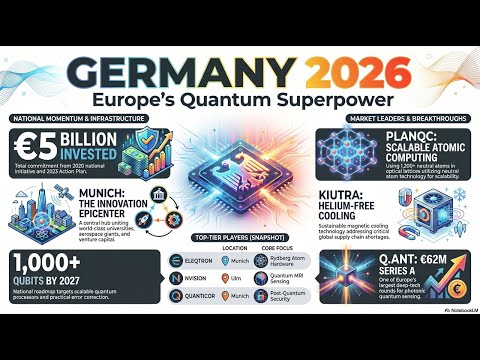
Germany may be known for its engineering precision, but in the realm of quantum technology, it’s crafting something more nuanced: a strategic blend of innovation, policy, and partnership. Our newest report, “Quantum Computing in Germany – 2025: State of the Union,” offers a clear-eyed view of the country’s steady march toward quantum maturity.
Strategy, Infrastructure & Intent
Germany’s national quantum strategy is structured and intentional, anchored by:
- Government-backed Quantum Computing Roadmap
- Public infrastructure projects connecting national labs, startups, and universities
- Direct investment in diverse quantum platforms, including superconducting and neutral-atom hardware
Collaboration + Academia
Germany’s strength lies in its deeply collaborative academic model, with research institutions like Fraunhofer, Helmholtz, and leading universities actively shaping both hardware and algorithm development. Educational pipelines are maturing, but the ecosystem still wrestles with a talent bottleneck, especially in quantum software engineering and commercial deployment.
Global Collaborations
Germany’s outlook is increasingly international. In 2025, we’re seeing:
- Robust EU partnerships, including coordinated research funding and infrastructure
- G7 alignment, with Germany taking a leadership role in post-quantum security standards
- Collaboration with U.S., Canada, and Japan on hybrid quantum-classical use cases
The G7 Summit 2025 spotlighted quantum not just as a scientific field but as a geopolitical one.
Key Opportunities
- Industrial Pilots: Automotive, energy, and chemical sectors are testing quantum workflows.
- Post-Quantum Cryptography (PQC): High urgency around cryptographic agility and retrofitting critical systems.
- VC-Backed Talent Development: New funds are supporting startups that combine quantum ambition with commercial realism.
Persistent Challenges
Despite momentum, Germany faces:
- A shortage of specialized talent
- Regulatory red tape stalling early-stage startups
- A slow commercialization pace compared to more aggressive ecosystems (like the U.S. or China)
- The rising urgency of PQC implementation as classical systems show growing vulnerabilities
Outlook for 2025 and Beyond
Germany’s quantum strategy is built for depth and stability rather than hype. We anticipate:
- Expansion of hardware diversity, with Europe-specific standards
- Growth in domain-specific use cases—particularly in energy systems, smart mobility, and chemical modeling
- A national push toward agile governance, including streamlined quantum funding channels
- Post-quantum security becoming mainstream policy in public and private infrastructure
Dig Deeper with Impact Quantum
Germany’s path is less headline-grabbing and more tectonic shift. And that’s exactly why it matters. While other countries sprint for short-term “quantum supremacy,” Germany is building infrastructure for the long game—an ecosystem that could quietly define the EU’s digital sovereignty.
📝 Download the full report:
“Quantum Computing in Germany – 2025: State of the Union”
→ ImpactQuantum.com
🎙️ Listen to the conversation on the latest podcast episode.
→ ImpactQuantum.com/Podcast