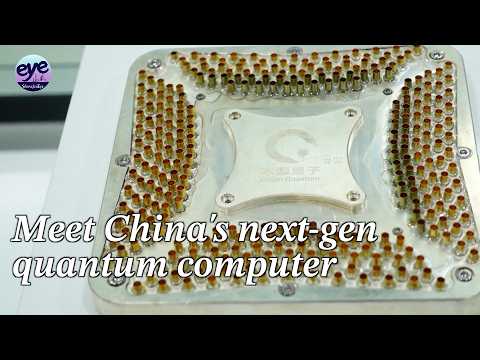
The quantum computing field is buzzing with news of China’s Zuchongzhi-3, a 105-qubit quantum processor that reportedly completed a benchmark calculation one quadrillion times faster than the world’s most powerful supercomputer. While this headline grabs attention, it bears a deeper dive to understand what these numbers truly signify and whether the result indeed marks a victory in the race for quantum supremacy.
Based on content from Tomorrow Engineered
The quantum computing realm is abuzz with the news of China’s Zuchongzhi-3, a 105-qubit quantum processor that reportedly completed a benchmark calculation a staggering one quadrillion times faster than the world’s most powerful supercomputer. While this headline grabs attention, it bears a deeper dive to understand what these numbers truly signify and whether this indeed marks a victory in the race for quantum supremacy.
At first glance, the astonishing computation speed of Zuchongzhi-3, achieved by a team at the University of Science and Technology of China (USTC), suggests a major leap forward. Yet, this “one quadrillion times faster” feat, though technically correct, is often misinterpreted. The processor’s prowess comes from executing a purpose-built benchmark task—random circuit sampling—rather than demonstrating broad, real-world computing capabilities.
To appreciate the complexity and significance of this achievement, one must delve into the world of superconducting qubits. These qubits, the elemental building blocks of quantum processors, exist in a state of superposition, allowing them to be both 0 and 1 simultaneously. However, the reliability of a qubit is governed by two critical factors: coherence time—the duration a qubit can maintain its state—and gate fidelity, which reflects the accuracy with which operations are performed on the qubits. Impressively, Zuchongzhi-3 exhibited a coherence time of 72 microseconds and gate fidelities of 99.9% for single-qubit and 99.62% for two-qubit operations.
However, quantum supremacy—the point at which quantum computers outperform classical counterparts—is but one piece of a larger technological puzzle. Since Google’s initial demonstration of a 53-qubit chip achieving quantum supremacy in 2019, classical computers have continued to evolve, closing performance gaps faster than anticipated. For instance, classical algorithms have substantially reduced the time required to match Google’s early quantum feats, highlighting the ongoing competitive tension between quantum and classical computational power.
In parallel, Google’s recent advancement with its 105-qubit Willow processor underscores this notion of a neck-and-neck race. Both Willow and Zuchongzhi-3 emerged within a week of each other, reflecting not an upset but rather synchronized historic milestones in quantum processing.
Yet, speed and qubit count do not solely define progress in quantum computing. The real breakthrough may lie in quantum error correction, where Google’s Willow demonstrated a significant achievement. By reducing the error rate exponentially as more qubits were added, Willow crossed a critical threshold—a crucial step towards making quantum computers practical and stable enough to run long-duration tasks without errors.
While the spotlight is currently on China and Google, IBM, albeit with less fanfare, is taking a uniquely strategic approach focusing on logical qubit stability and error correction. IBM’s roadmap towards a fault-tolerant quantum computer, targeting stability rather than speed, promises practical quantum advantage by adopting novel error-correcting code strategies that drastically reduce the physical qubits required.
As we distill these quantum advancements, it becomes clear that the race is far from over. The definition of “winning” remains fluid, defined more by application potential and cross-disciplinary impact than by sheer speed or qubit count. Quantum computing’s real transformative power will likely emerge from applications in artificial intelligence, cryptography, and other realms that exploit its unique problem-solving capabilities.
Ultimately, the true narrative of quantum computing is a multifaceted journey of innovation where speed and power are only part of the story. The questions worth asking are: How will these advancements translate into tangible benefits? What new frontiers will become accessible as quantum and classical technologies continue to evolve symbiotically? As we ponder these, the quiet race to build the world’s first practical quantum computer continues, armed with an ever-increasing sense of urgency and possibility.
—